A Front Door for Founder Submissions, Built with SAVA-P
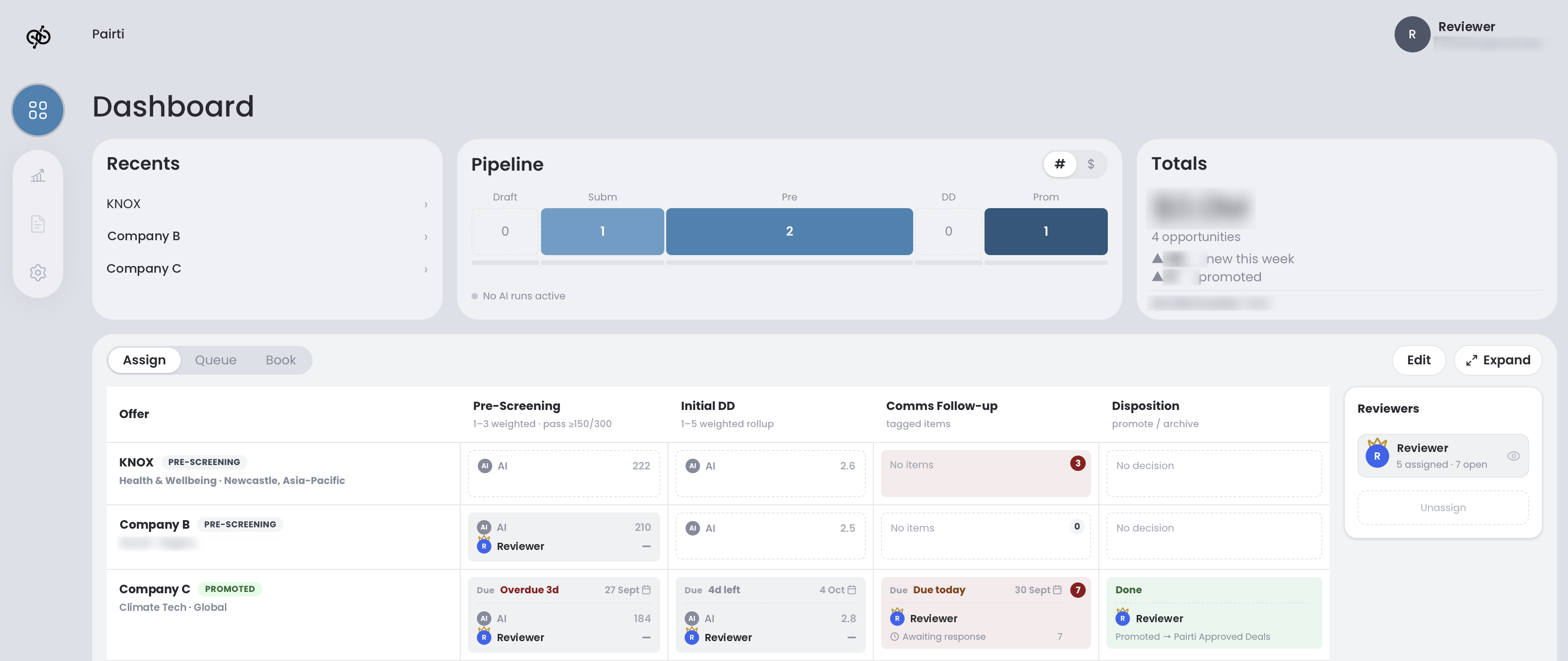
In these screens we’ve swapped people’s names for their roles and given the other submissions placeholder names. Financial figures, contact details and some of the other submissions’ details are blurred or removed, and the dashboard is cropped.
If you run a fund, lead an angel group or sit on an investment team, you already know where the week goes. Decks arrive faster than anyone can read them properly. The claims inside them take real effort to test, and the follow-up emails to founders tend to wait until someone finds a spare evening. Your people know what a good deal looks like. What they rarely have is the time to give every submission a careful first read before they decide.
SAVA-P, our client, knows that week well. SAVA-P is a secure deal sharing platform. It operates where finance meets investor relationships, running curated deal flow, data rooms and email engagement, and empowering values-aligned engagement and investor relationship management. Anna’s team already owned that mandate and a substantial platform around it. What they needed was a front door, a place where founder submissions could come in, be read and triaged with care, and move into SAVA-P once an opportunity was ready to share. So Pairti built SAVA-F as a complementary solution for SAVA-P clients, and I’d like to show you how it works on a real deal.
We put Knox, one of Pairti’s own portfolio companies, through the live product in Pairti’s own workspace, exactly as any founder’s deck would go through it, and we kept the screens. They show Knox at one point in its life. The full walkthrough has every screen from that run with more detail on each step, and it’s the best place to see the product properly. What follows here is the shorter version, and why it matters if you’re thinking about something similar for your own deal flow.
Why SAVA-F was built with SAVA-P
SAVA-P is also a platform that other applications can extend, and SAVA-F is the first application built for it. It’s a standalone app that connects to a deal room, starting with SAVA-P and its secure data rooms, and it was shaped as a curator-led front door that promotes selected work into SAVA-P rather than living as a disconnected sidecar. Pairti came in with fractional technical leadership across SAVA-P and SAVA-F. We built the direction with Anna’s team in the loop, and we kept the investment call with the people who own the mandate. The AI assists with triage and workflow, always with a person keeping an eye on what it does.
In practice, SAVA-F works as a pitch deck reviewer and investment due diligence tool for the curators, giving each submission branded intake, AI-supported triage and structured curator review.
Deal analysis from submission to shortlist
A deal starts when a founder submits, and SAVA-F respects their time from that first step. The AI reads the data pack they upload and fills in most of the submission form for them. The founder checks what’s there, changes anything that needs changing and submits, so they keep full control over what reaches you and your team gets submissions that arrive consistent and ready to read.
From there every opportunity sits in one pipeline, from draft through submission, pre-screening and due diligence to promotion. This is where your team shares the due diligence, because you can see where your deal flow is bunching up, who owns each deal at each stage, what the AI has already scored, which founder follow-ups are waiting on a reply and what has been decided. When Knox came in, the AI’s pre-screening score of 222 out of 300 was on the board against a pass threshold of 150, and an initial due diligence score of 2.6 out of 5 was waiting for a reviewer.
Pitch analysis that checks the claims first
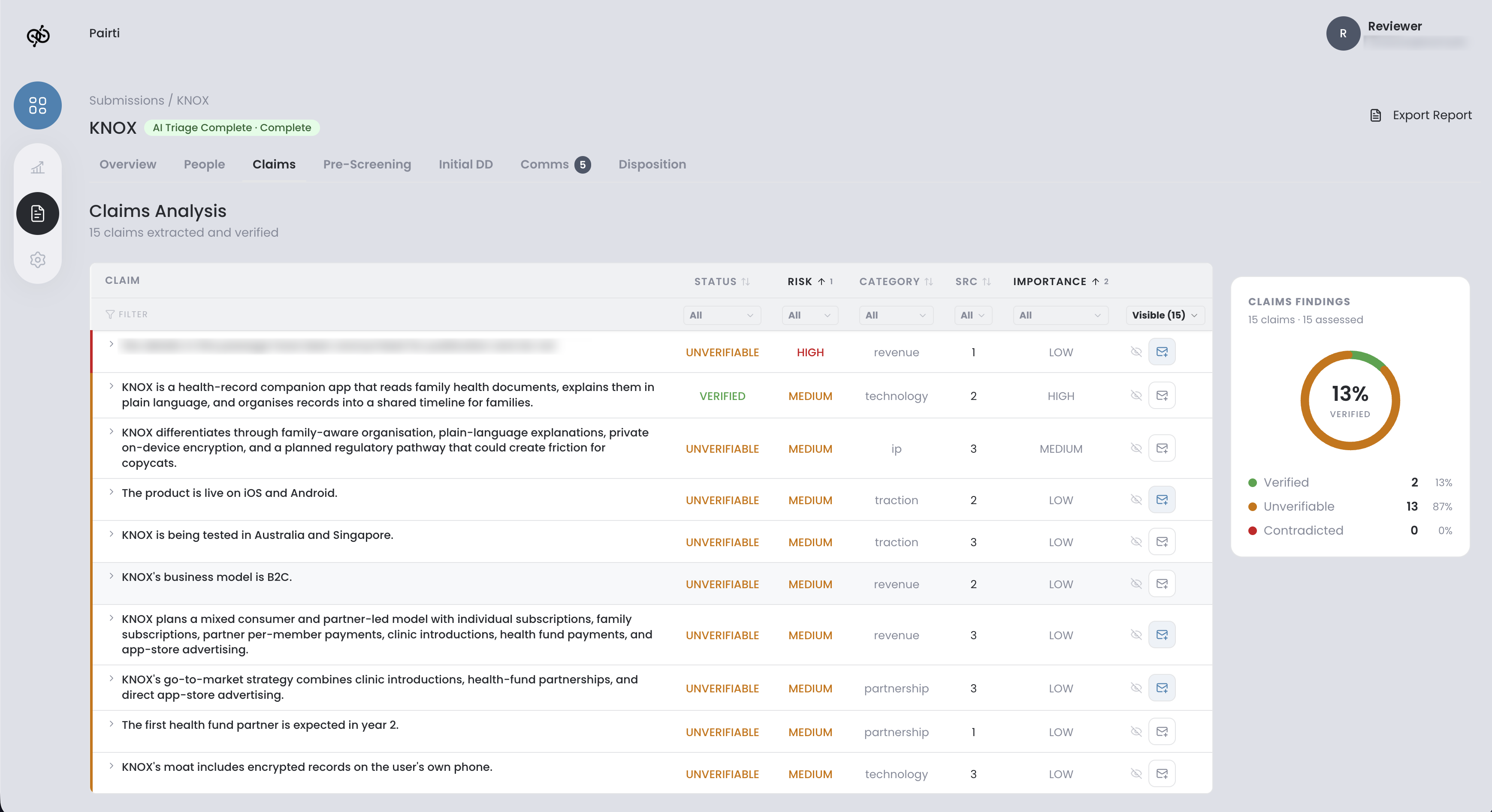
Testing what a deck says is usually the slowest part of early diligence, so SAVA-F does it first. Every factual statement becomes a row with a status, a risk rating, a category, the number of sources checked and an importance rating, and each one comes back verified, unverifiable or contradicted. For Knox, the core description of the product was verified, while claims such as the product being live on iOS and Android came back unverifiable from what was available. Across 15 claims, 2 were verified, 13 were unverifiable and none were contradicted.
Your reviewer can see quickly where to push, and any claim can be tagged for follow-up with the founder.
Your reviewers make the call
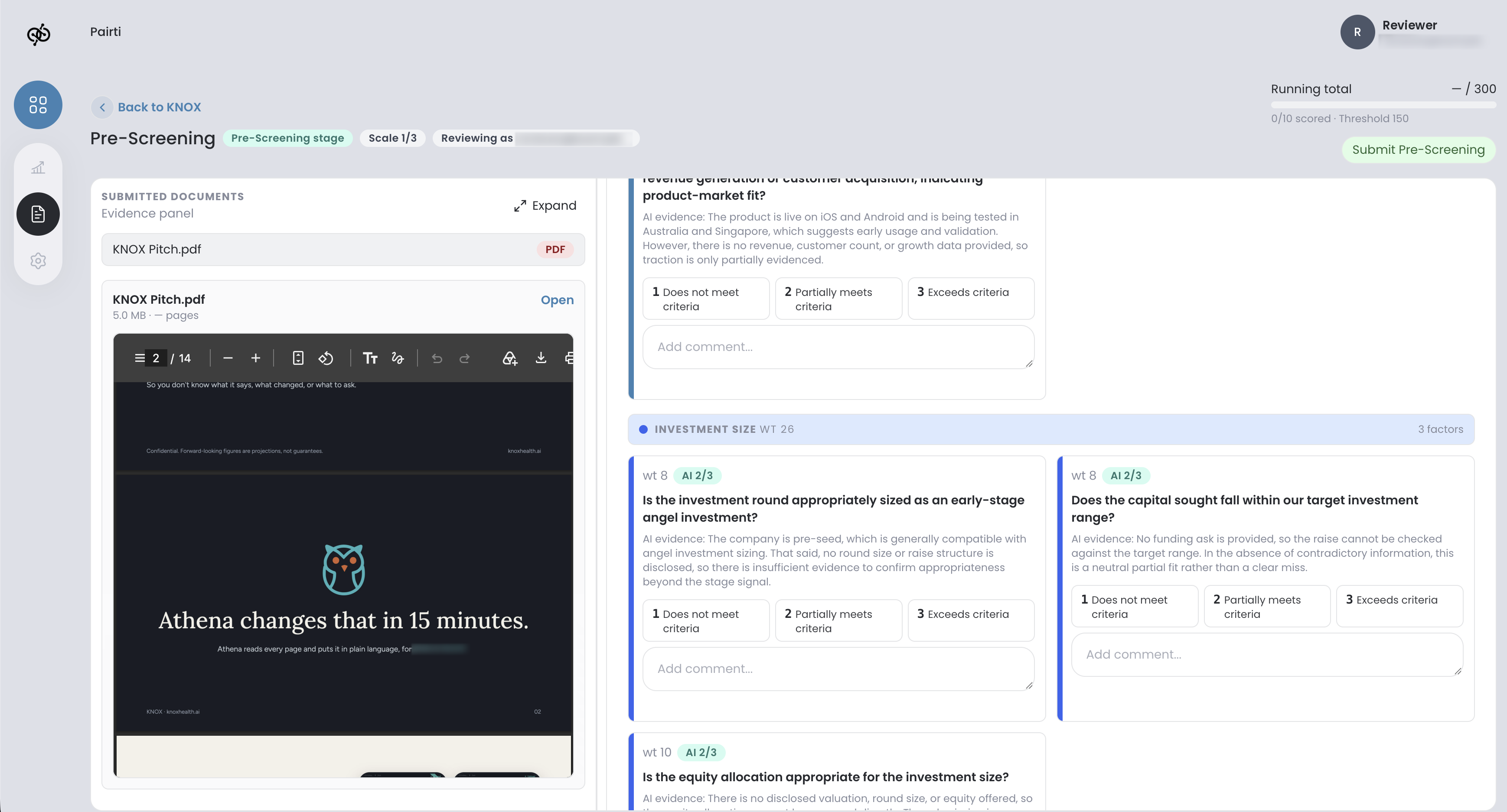
This is the part I care about most. In pre-screening the founder’s deck sits open on one side so your reviewer can check anything against the source. On the other side, each weighted screening question shows the AI’s evidence in a sentence or two and the score it would suggest, clearly marked as a suggestion. The score buttons stay empty until your reviewer picks one, and the running total only counts what your reviewer has scored.
The AI does the reading and makes its case. The score that counts is always your reviewer’s, and every score, decision and message sits with a named person, so it’s always clear whose judgment a number represents.
Follow-up that stays with the deal
When claims can’t be verified, the natural next step is to ask the founder, and SAVA-F drafts that email for you. The draft to Knox thanked the founder, named the points that couldn’t be substantiated from the materials, said what had been confirmed so nobody was asked twice, and asked how the planned regulatory pathway protects the product from copycats. Your reviewer checks it and sends it from the platform. The activity log records when it was drafted and when it went out, so the thread stays attached to the deal instead of disappearing into someone’s inbox.
When the founder replies, their answers and any attachments flow back into the deal and the AI re-scores the claims and screening questions they touch. Later due diligence passes take that Q&A into account too. The scores your reviewers see reflect the conversation so far, and the decisions stay with them.
What this could look like for you
A good investment analysis tool shouldn’t replace your judgment, and this one was never meant to. What it changes is how much reading, checking and drafting your team has to get through before they use that judgment. Every deck gets the same careful first read, the evidence is laid out in front of the person deciding, and the conversation with each founder stays with the deal.
If your team reviews founder submissions and you’d like to talk about a front door for your own deal flow, I’d love to hear from you. The full Knox walkthrough has every screen if you want to see more first, and you can read how the SAVA-P engagement came together. Then drop me a line at grant@pairti.com.au. Tell me a little about how submissions reach you today, and we can take it from there.

SIGO (S#*t In, Good Out): Structured PDF Analysis for AI-Native Applications
If your software has to act on badly laid out regulatory PDFs, you need structure you can trust before any model reasons over them. See what held up when we compared plain text, Docling, cloud vision models and a small model on a laptop, and where each one still slips.
Read Article
Good Managers Get Leverage. Bad Managers Meet the Gravity Well.
Agents run your brief at speed and often won’t flag a bad one. A clear brief is where the leverage starts, and checks the system can run are what make it hold.
Read ArticleStart with a Diagnostic
A Diagnostic is a short, scoped engagement. We sit with your stack, your risk, and your readiness, and we write down what we find.
Ask about a Diagnostic