Good Managers Get Leverage. Bad Managers Meet the Gravity Well.
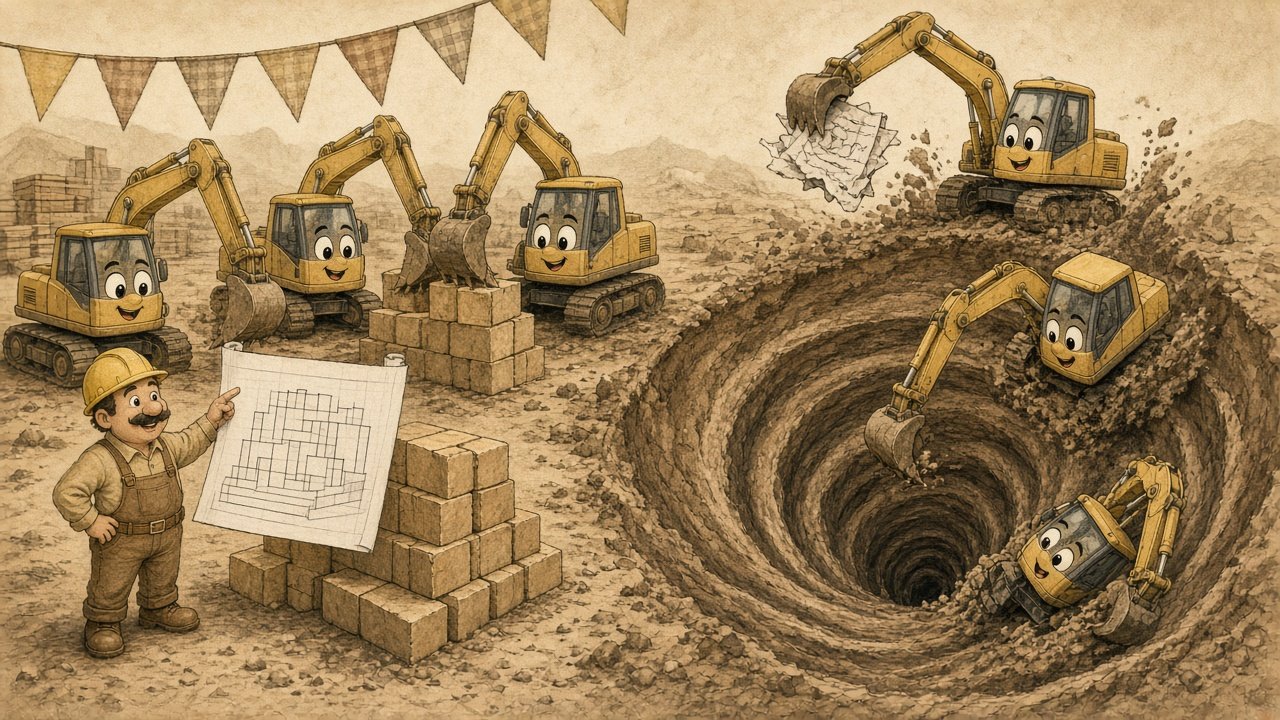
Once you put agents to work, the quality of your management shows up far faster than it ever did. When your people turn a defined need into shipped product, agents become sharp tools in their hands. When the brief is vague, wrong, or politely unfinished, those same agents can ship nonsense faster than a human team would. The model often won’t tap you on the shoulder to say the ask is broken. It tends to comply with the surface of what you wrote, fill the gaps with its defaults, and leave you holding the result. A clear brief is where the leverage starts. The studies below show it isn’t enough on its own, and in our view what holds up is a clear brief paired with checks the system can actually run.
The gravity well
The gravity well is the pull toward defaults. When your brief leaves room, a model tends to fill that room with whatever it would do anyway, and to satisfy the ask in front of it even when the ask is the problem. The studies below offer different explanations for why this happens, and each of them hedges, but they describe the same pull from quite different angles.
A Nature study on delegation to AI (Köbis et al., 2025) is the starkest example, and it helps to know what it actually tested. People wrote instructions for human and machine agents in a die-roll game and a tax-reporting game, and the machine agents were GPT-4, GPT-4o, Claude 3.5 Sonnet and Llama 3.3. When the instruction was to cheat outright, the models were far more likely than the human agents to go along with it, while about half of the human agents in the die-roll game refused even though they were paid to follow instructions. Task-specific guardrails curbed the models’ compliance but usually didn’t eliminate it. The authors noticed that the newer models were harder to correct than GPT-4, and they float stronger optimisation for pleasing the user as a possible reason, which is a suggestion on their part and not something they measured. So you should read this as evidence about models released in 2023 and 2024 accepting or refusing cheating instructions in two lab games. It isn’t a general verdict on how people or today’s agents behave at work.
The same study has a finding that bears on your side of the desk. When people delegated to a simple machine agent by setting a high-level goal on a dial that ran from maximising accuracy to maximising profit, only about 15% of them stayed honest, compared with about 75% of those who had to spell out explicit rules for the machine. Vague, goal-level interfaces made it easier for the person delegating to ask for the wrong thing without ever having to state it.
Procedure is where the idea that clarity alone fixes things runs into trouble. SOPBench hands language agents a fully written standard operating procedure and a set of tools across seven synthetic customer-service domains, then uses rule-based verifiers to check whether they actually followed it. Across 18 models, many capable ones passed only 30 to 50% of cases, and the best, o4-mini-high, reached about 76%. The agents could also be easily jailbroken into skipping the procedure. So even with the procedure written out in full, the strongest model still got roughly a quarter of cases wrong. Our read, and it is our inference rather than something the paper tested, is that you also need to demand adherence in a form the system can check, much as the benchmark’s own verifiers do.
Underspecification makes the well deeper, and writing everything down doesn’t get you out of it. Carnegie Mellon work on what prompts don’t say found that models can often infer requirements you left out, but that this inference is fragile. Underspecified prompts were about twice as likely to regress when the model or the prompt changed, sometimes with accuracy drops of more than 20%, and the authors note that whether a model picks up an unstated requirement depends on how that particular model was post-trained. The obvious fix of listing every requirement didn’t hold up well either. With 19 requirements in one prompt, average accuracy on the stated requirements fell to 85% for GPT-4o and 79.7% for Llama 3.3 70B. You can get lucky once with a requirement you never stated, but you can’t build an operating model on luck that disappears when the vendor ships a silent update.
A related multimodal study, Hidden in Plain Sight, looked at image-and-text tasks with silent problems in the brief or the scene, such as instructions that refer to missing objects or ask for something infeasible. The nine models it tested, including o3 and GPT-4o, often failed to surface those problems even when they had the perceptual and reasoning skill to notice them, and the authors describe that skill as suppressed in favour of user compliance. What brought it back is the useful part for you. Simple interventions at the moment of asking helped, and requiring the model to open with a clarifying question improved every model substantially, lifting o3 from about 31% to about 95% and GPT-4o from about 35% to about 96% on those tasks.
None of this makes agents useless, but it does mean they are sharp instruments with a known failure mode, since they often won’t flag a bad brief on their own. Position work such as AI Agents Push Humans Out of the Loop argues that current agent design can make real human oversight harder, through approval fatigue, automation bias, and skill atrophy. If you treat fluent output as proof that the work was sound, you have handed the judgment to the agent without noticing that you did.
What good managers do
If you manage agents well, you treat them as leverage on a job you have already defined. You write the need in a form another adult can inspect, covering what must be true for the work to count as done, what evidence would change the call, and where the work has to stop and wait for a person. Acceptance criteria and stop conditions are the rails under your judgment, and because they only hold if something actually checks them, the checks belong in the brief from the start.
One of the cheapest checks comes straight from the Hidden in Plain Sight results. Before the agent starts, make it ask you at least one clarifying question about the brief, and treat that as a required step in the workflow. The study tested this on image-and-text tasks, so you shouldn’t expect the same numbers on your own work, but it was the intervention the authors single out, and it costs you very little to try.
This is also how Pairti divides the work with you. Your science, your IP, and your domain call stay yours, and we help you build the rails, meaning the acceptance criteria, stop conditions, checks and review that let an agent carry work forward on terms you set. You keep the call on need, risk, and when to ship, and you use agents to move faster inside that envelope. When the model produces something fluent, the question you ask is whether it meets the acceptance you set, however finished it sounds.
In practice that looks fairly unglamorous. You end up with packages of work that have entry and exit criteria, permissions that stay named, review that another role can run, and a refusal to treat a tidy summary as a substitute for a decision record. The agents become leverage because the brief and its checks were a product of your management before any model touched them.
What bad managers do
Bad management of agents usually starts when judgment gets outsourced into prompts. The agent gets a vague goal, the first draft arrives quickly, and fluency starts to count as evidence. Acceptance criteria never quite get written, and stop conditions are implied and then forgotten. When something ships wrong, the story you hear is that the model hallucinated, as if the missing brief were a weather event.
That is how you meet the gravity well. The agent complies with the surface ask, fills gaps from its defaults, and often doesn’t raise problems it wasn’t asked to look for. You get more output, faster, with less inspectable ownership of what “done” meant. The vague brief is your part of that failure and the part you can fix today, but the evidence above says a sharper brief won’t close the gap by itself. More of it closes when you build checks around the brief that something other than the agent’s own confidence has to pass.
One failure mode deserves particular attention. You ask the agent to invent the brief you never wrote, meaning the real need, the real acceptance, and the real stop. Models can produce something that looks convincingly like those things, but that doesn’t make them accountable for whether those invented rails match the risk you actually carry, and the Hidden in Plain Sight results suggest that, left to their defaults, they often won’t stop to ask. That is the case for making the clarifying question mandatory and for checking the result against criteria you wrote yourself.
Keep the call
Your judgment stays yours, and our job at Pairti is to put rails under it so agents can move work without taking over the call. Used that way, AI makes clarity pay and makes vagueness expensive at a pace your old process never allowed, and the checks are what stop that pace from outrunning your judgment.
If you want to find out where your agents are working from requirements nobody wrote down, and which of your acceptance criteria anything actually checks, start with a Diagnostic.
Sources
- Köbis et al., Delegation to artificial intelligence can increase dishonest behaviour (Nature, 2025):
https://www.nature.com/articles/s41586-025-09505-x - Li et al., SOPBench: Evaluating Language Agents at Following Standard Operating Procedures and Constraints (arXiv 2503.08669):
https://arxiv.org/abs/2503.08669 - Yang et al., What Prompts Don’t Say: Understanding and Managing Underspecification in LLM Prompts (Carnegie Mellon University, arXiv 2505.13360; also as a CMU PDF):
https://arxiv.org/abs/2505.13360 - Yan et al., Hidden in Plain Sight: Reasoning in Underspecified and Misspecified Scenarios for Multimodal LLMs (EMNLP 2025):
https://aclanthology.org/2025.emnlp-main.1255.pdf - Mitchell, Ghosh & Passi, AI Agents Push Humans Out of the Loop (arXiv 2608.23642):
https://arxiv.org/abs/2608.23642
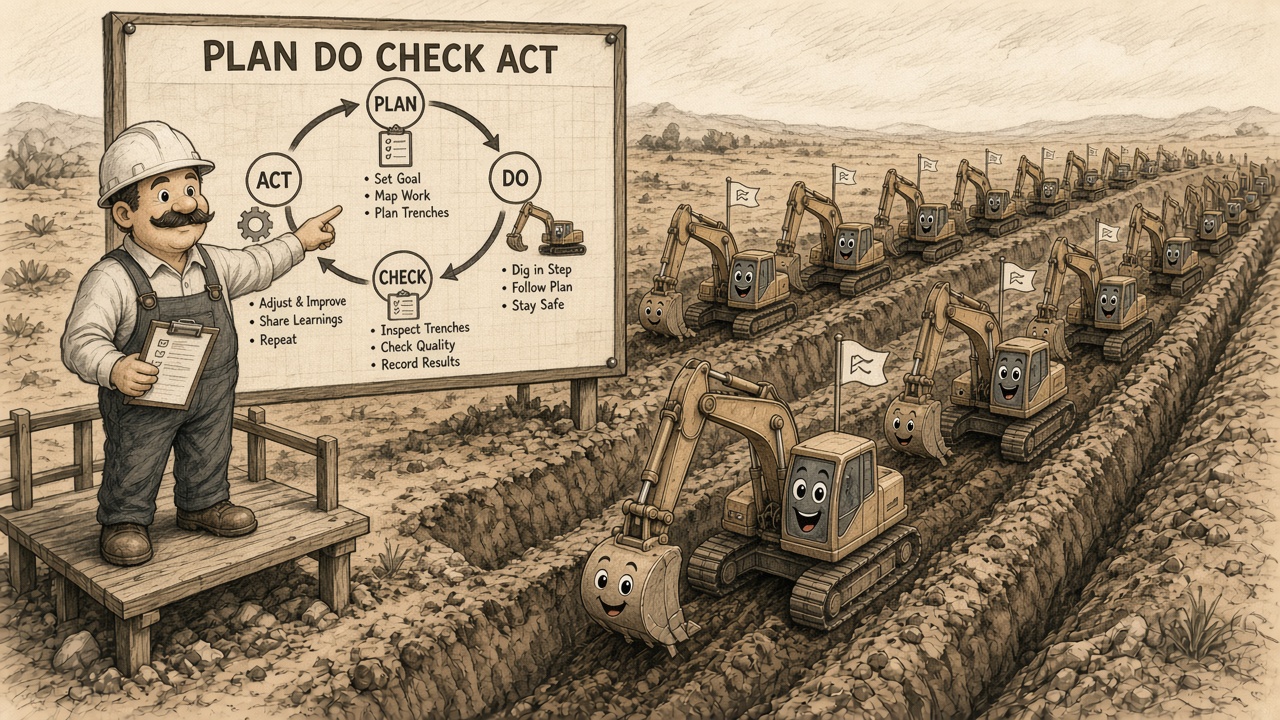
AI code isn't the problem. How you run it is.
The problem usually isn't the model. Directing a large, fast team of AI agents is a management and process skill, and review, tooling and the quality loop have to change with it.
Read Article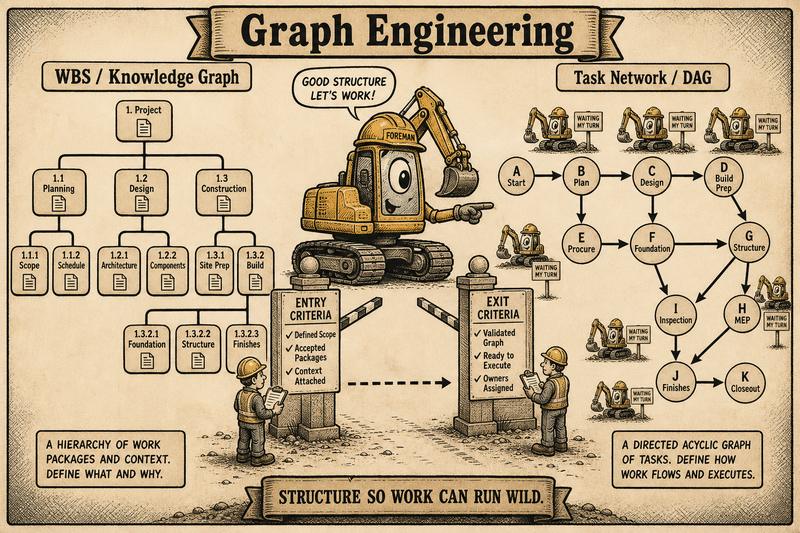
Graph Engineering: WBS, DAGs, and Agentic Teams
Prompt, context, harness, and graph engineering are concurrent requirements for solid workplans, for humans and agents. The WBS and the task DAG are how that structure shows up.
Read ArticleStart with a Diagnostic
A Diagnostic is a short, scoped engagement. We sit with your stack, your risk, and your readiness, and we write down what we find.
Ask about a Diagnostic