Graph Engineering: Why Your WBS Is the Right Model for Agentic Teams
Prompt, context, harness, and graph engineering are concurrent requirements for solid workplans, not a fashion cycle you pick one from. Humans needed them too; agents just make the gaps louder and faster. A WBS embeds the knowledge graph, a task network embeds the execution DAG, and the organisational problems stay the same even when cycle time collapses.
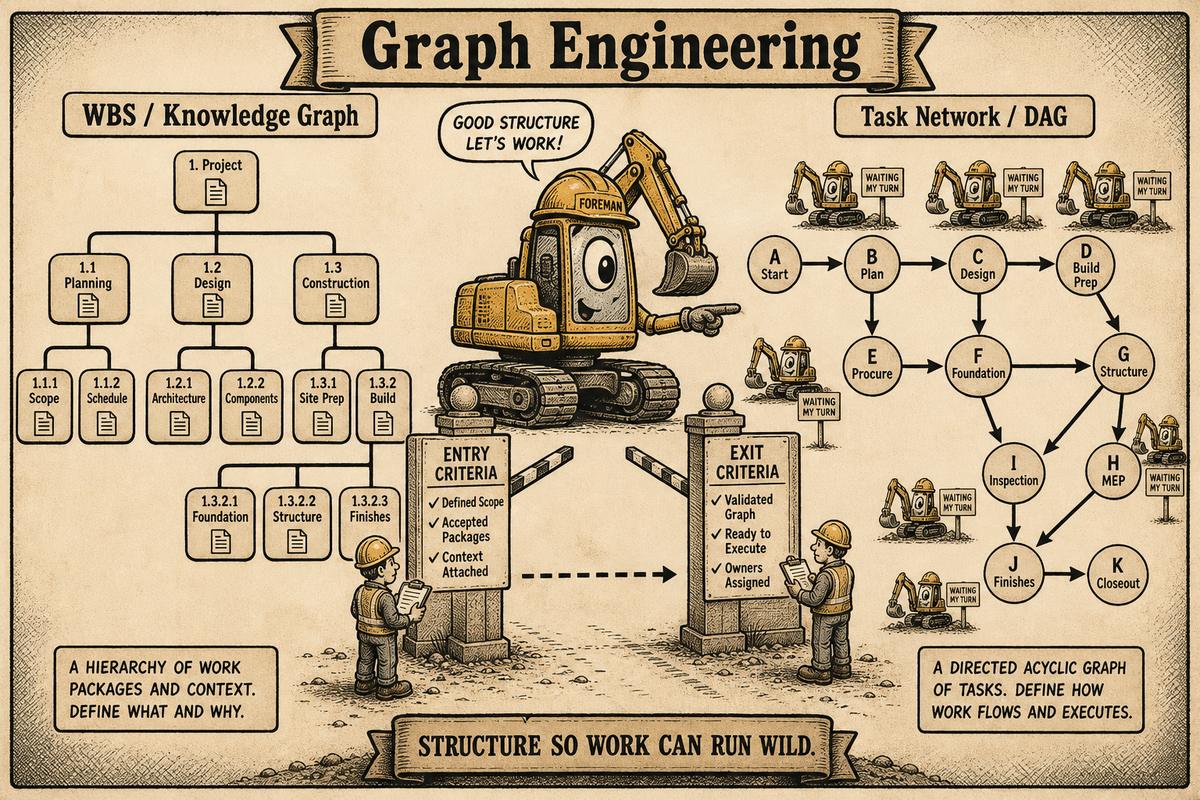
We are living through the naming of graph engineering, not as the next fashion after prompts, but as the practical discipline of how work, knowledge, and agency get structured when machines can execute beside us at machine speed. It sits alongside prompt, context, and harness engineering, not after them.
The industry’s instinct is to invent a new vocabulary for agents: swarms, crews, orchestrators, tool routers. Useful toys. But the underlying shape of the problem is older than Agile stickers and newer than punch cards. It lives in every serious schedule and every honest Work Breakdown Structure.
If you already know how to organise people against a WBS and a task network, you already know most of what you need to organise agentic engineers. The difference is cycle time, the ability to iterate and build with more agents, faster. The key problems do not disappear.
Prompt, context, harness, graph, all at once
The industry likes to narrate AI craft as a sequence of eras: first we discovered prompt engineering, then we grew up into context engineering, then we got serious about harness engineering, and now we talk about graph engineering.
That story is useful marketing. It is bad systems thinking.
These are not phases. They are concurrent requirements for any solid workplan, whether the executors are humans, agents, or both.
- Prompt engineering: the instruction at the point of action: what to do, to what standard, with what constraints. Humans get a brief. Agents get a prompt. Vague either way and you get confident nonsense.
- Context engineering: what knowledge is attached to that action: the package of facts, standards, interfaces, and prior decisions required to execute without inventing tribal lore. In a WBS, that is the knowledge bound to the node.
- Harness engineering: the runtime that keeps work inside the pad: tools, permissions, review loops, tests, allowlists, stop conditions. The site fence and the safety gear. Without a harness, speed is just a faster way to take out the neighbour’s fence.
- Graph engineering: how work and knowledge are structured across the whole: the knowledge graph in the WBS, and the execution DAG in the task network, with entry and exit criteria at each step.
Skip any one of them and the others degrade. A perfect prompt with no context hallucinates. Rich context with no harness leaks. A beautiful graph with mushy prompts and no gates is theatre. You need the set, every time you plan real work.
Humans always needed this. We just buried it under job titles, stand-ups, and “you’ll pick it up from the wiki.” Agents do not pick it up from the vibe. They force us to make the concurrent requirements explicit again.
Two graphs hiding in plain sight
A mature delivery system already carries two graphs. We rarely name them that way.
1. The knowledge graph in the WBS.
A Work Breakdown Structure is not just a nested list for the PMO. Done properly, it is a map of the product and the work: decomposition, ownership, interfaces, and the context that belongs at each node. Parent packages hold intent. Children hold scope. Cross-links hold dependencies that are conceptual before they are chronological. That is a knowledge graph, what exists, how it relates, and what an executor needs to know when they touch a node.
2. The execution graph in the task network.
The schedule, the DAG of activities, predecessors, successors, lags, and milestones, is the execution graph. It answers a different question: given what we know, in what order may work proceed, and what must be true before a node can start or finish?
Confuse the two and you get classic failure modes: beautiful hierarchies with no runnable plan, or frantic task boards with no shared understanding of the system being built. Separate them cleanly and you get something agents can actually use.
Organising agents is organising people
Put a dozen agents on a codebase without a WBS-shaped knowledge structure and you do not get a team. You get concurrent interns with overlapping context windows and no shared map.
People need:
- a clear package of work,
- the context for that package (and only that package, when possible),
- known upstream inputs,
- known downstream consumers,
- and someone accountable for the handoff.
Agents need the same things. They are worse at inventing tribal knowledge and better at burning tokens while looking confident. So the discipline matters more, not less.
Roles still matter, architect, implementer, reviewer, integrator. Handoffs still matter. Authority still matters: who may change the plan, who may merge, who may declare a gate passed. Calling them “agents” does not dissolve organisational design. It compresses it.
Entry and exit criteria are the guardrails
In a classical schedule, gates are not bureaucracy for its own sake. They are the only reliable way to stop unfinished work from poisoning everything downstream.
Entry criteria ask: is this node allowed to start? Is the required context present? Are upstream artefacts accepted? Are interfaces frozen enough?
Exit criteria ask: is this node actually done? Not “the agent said done”, done against a checklist that another role can verify.
Those gates are how you keep an excavator on the site survey. Without them, agentic systems dig fast, dig wide, and dig into the neighbour’s fence, then leave you a beautiful commit history of the damage.
This is the same lesson as standards-as-executable-context and review-led delivery: structure is what lets innovation run wild inside the pad.
What actually changed: cycle time
People are slow relative to agents. That forced us to batch context, hold long-lived ownership, and accept that replanning was expensive.
Agents invert the economics:
- you can spawn more specialised workers against more nodes of the WBS,
- you can replan the DAG more often,
- you can run narrower slices with tighter context,
- you can afford verification loops that would have been politically impossible on a human-only team.
That is the opportunity, and the trap. Faster iteration without a knowledge graph and an execution DAG just means you fail the same organisational tests at higher frequency. Cycle time amplifies whatever structure you already have. If the structure is mush, you get mush at GPU speed.
A practical model for agentic engineering
Treat agentic delivery as graph engineering:
- Maintain a WBS-shaped knowledge graph: decomposition, interfaces, ownership, and the context packs that belong to each node.
- Maintain a task-network DAG: ordered work with real predecessors, not a flat backlog of vibes.
- Bind agents to nodes: give them the context for their package, not the entire company history.
- Enforce entry and exit criteria: machine-checkable where possible; human-owned where judgment is the product.
- Replan aggressively: the DAG will be wrong; that is fine if you can see it and rewrite it.
This is not anti-Agile. It is Agile with a spine. The excavator is allowed to move earth quickly because the site is surveyed, the utilities are marked, and the foreman still owns the gates.
The foreman’s job did not go away
Graph engineering is the reappearance of systems and program discipline in a world that briefly pretended prompts were enough.
Organising agents is organising people, with shorter cycles and sharper tools. The knowledge graph in the WBS, the execution graph in the task network, and the entry/exit criteria at each step remain the hard problems. Solve those, and more agents become leverage. Skip them, and more agents become a more expensive way to dig the wrong hole.
At Pairti, that is the work: craft the structure so innovation, human and agentic, can run wild without taking out the fence.
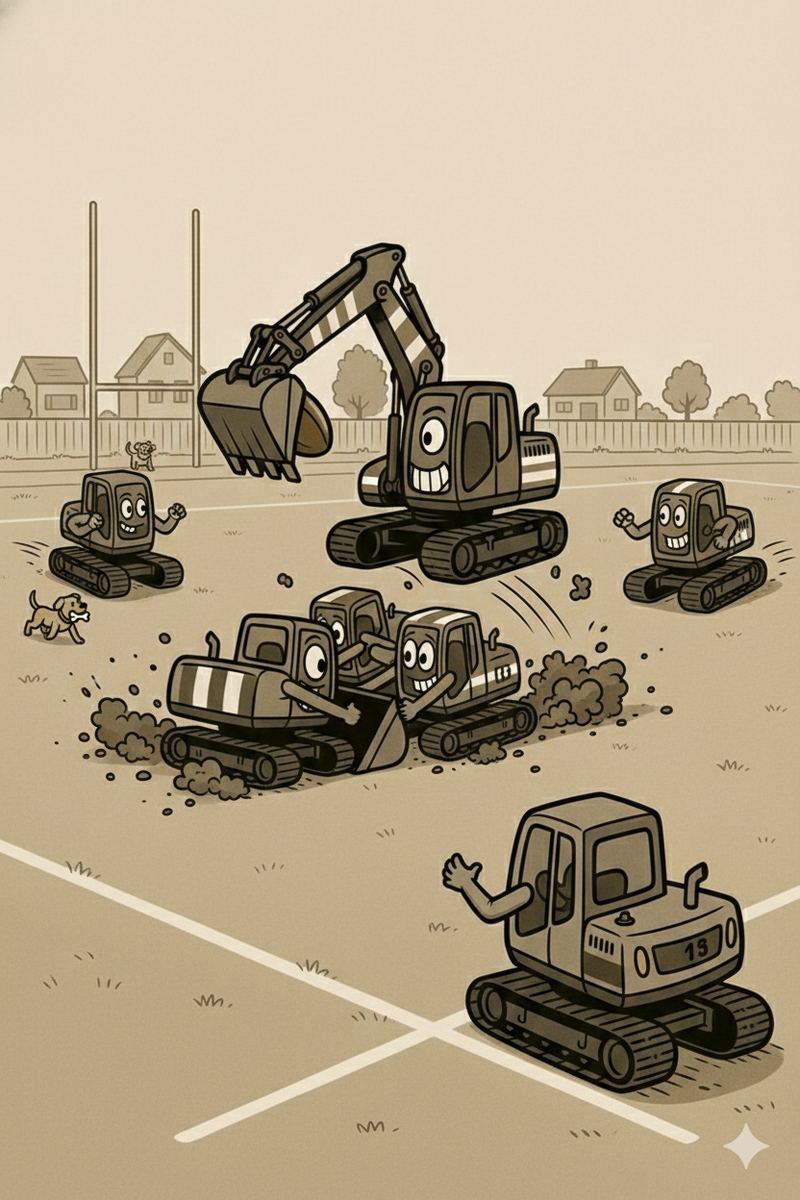
The Foreman’s Desk: Schedule Discipline in the Age of AI
Agile task lists fail at AI scale. Learn how we use BP6 to bring program scheduling discipline and Critical Path analysis to the "AI Excavator."
Read Article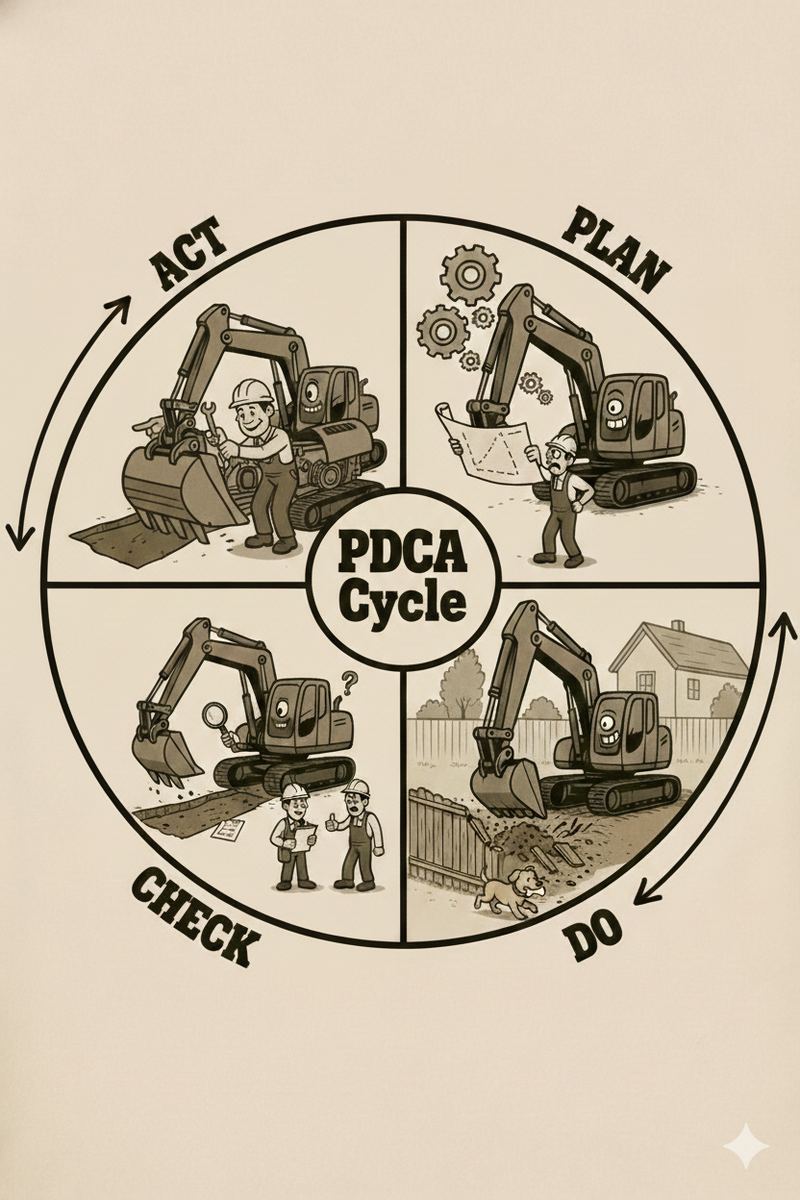
The Physics of AI Orchestration
Orchestrating agents looks a lot like orchestrating massive programs of work. How to use Systems Engineering principles to master AI.
Read ArticleStart with a Diagnostic
A Diagnostic is a short, scoped engagement. We sit with your stack, your risk, and your readiness, and we write down what we find.
Ask about a Diagnostic