The Physics of AI Orchestration: Not Re-inventing the Wheel Might Be Our Secret Weapon
Orchestrating agents looks a lot like running a factory: you track digital waste, and you use feedback loops so the line corrects itself. Progressive elaboration beats one giant prompt, and Plan-Do-Check-Act cycles that used to take weeks now happen in seconds, which is exactly why the loops have to be designed on purpose.
I grew up in organizations that built massive, complex, and expensive systems, submarines, naval vessels, combat systems, and aeroplanes. Over decades, some "bloody good" tools were developed to orchestrate the production of these systems, managing the complex dance of scope, risk, resources, and dependencies.
There is a frantic search in AI circles for a robust approach to "Agentic Orchestration", a complex term for getting multiple AI models to work together without chaos. We talk about "emergent behavior" and "agentic workflows" as if we’re inventing fire, obsessing over the "output", the code, the content, the clever chat response.
But here is the truth: Orchestrating agents looks a lot like orchestrating those massive programs of work.
The generalized meta-problem of coordinating resources reliably has been worked on by smart people for decades. No doubt, AI agents have specific considerations. However, the core challenges, scope creep, context loss, and fragmented output, are old enemies. We don't need to reinvent the wheel; we can leverage the proven "physics" of Project Management, Systems Engineering, and Lean Six Sigma to master AI orchestration.
The System that Builds the System
The intellectual grandfather of this idea is W. Edwards Deming, the father of modern Quality Management, who famously said:
"Every system is perfectly designed to get the results it gets."
Deming's insight is that the system is the problem.
Elon Musk popularized the phrase "building the machine that makes the machine" around 2016. His argument was that while designing a car (the product) is hard, designing the factory (the system) is 1,000% harder. "Orchestration" is that factory.
Production System Architecture
Our production architecture consists of two main subsystems:
- The "Factory" (Execution): The Work Breakdown Structure (WBS) and the agents that execute it. This is our LEAN manufacturing system, populated by AI workers.
- The "Optimizer" (Control): An instrumented control layer sitting above the factory. This is analogous to a process improvement, quality control, or Six Sigma team.
We don't just measure the final product; we measure the process. We track "Digital Waste" (Muda), latency, token over-consumption, and logic variance. This creates a cybernetic loop: when the system detects a deviation in task execution, the control layer applies a "soft correction", adjusting agent parameters, re-routing dependencies, or refining prompt templates in real-time.
The Waterfall Myth: Progressive Elaboration
Modern critics often dismiss traditional project management as "Waterfall", the idea that you must plan every detail before starting. In reality, complex, high-risk projects have always used Progressive Elaboration (or Rolling Wave Planning).
You plan what you know in detail and leave the distant horizon in broader "epics." As you move forward, the "wave" of detail rolls with you. AI thrives in this model. Instead of asking one agent to "Build an App" (an impossible prompt), we use a hierarchical approach:
- The Executive Layer: Defines the vision and high-level epics.
- The Planning Layer: Elaborates those epics into features.
- The Execution Layer: Drills down into specific, executable tasks.
The Speed of PDCA
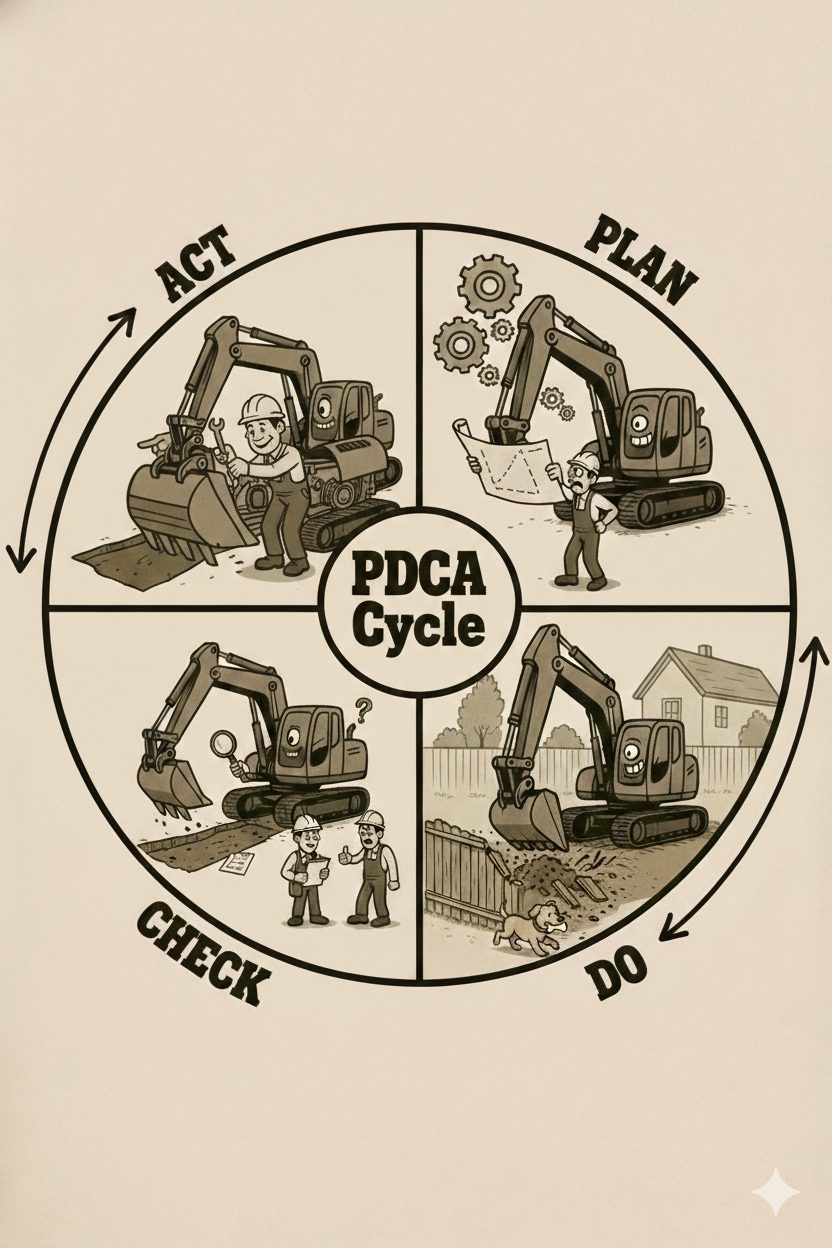
At every level of this decomposition, we apply the Plan-Do-Check-Act (PDCA) cycle. In a human-led project, a PDCA cycle might take weeks. With AI agents, it happens in seconds.
- Plan: The WBS is progressively elaborated and agents are assigned specific scopes.
- Do: Agents execute within their sandboxed nodes (generating code, designing architecture, writing content).
- Check: The Control Layer measures output against Critical-to-Quality (CTQ) metrics. A peer-review agent or testing suite validates constraints.
- Act: The system self-corrects, optimizing the factory for the next cycle. The agent iterates based on feedback, or the "leaf node" is approved.
Because we execute these cycles so rapidly, the project doesn't just move faster, it becomes more accurate. The system effectively "self-heals" its own project plan.
A Recursive Architecture
This process is recursive. The methodology used to define a product vision is the same as that used to write a function. Each level of the WBS is a fractal of the whole, applying the same approach, with specialized skills, at a different scale.
Agents are Not People (But the Process is the Same)
While the meta-process of management remains constant, agents are a peculiar resource. They don't need motivation, but they do require:
- Rigid Scoping: To prevent context drift and hallucinations.
- Skill Configuration: Mechanisms (like Model Context Protocol) to provision specific "tools" for their task.
- Recursive Guidance: Inheriting context from the parent level to ensure the "leaf" task serves the "epic."
The Bottom Line
The "Solved Problems" of the 20th century, reducing variance, eliminating waste, and hierarchical decomposition, are the secret weapons of the 21st.
We don't need to reinvent the wheel every time a new technology emerges. The "physics" of work, technical dependencies, budget constraints, and architectural integrity, remains constant. By using Structured Decomposition to define scope and Progressive Elaboration to manage uncertainty, we can reduce "prompting and praying." We start orchestrating AI with the same precision used to build skyscrapers and spacecraft.
We aren't breaking the old rules; we're finally giving them the engine they deserve.
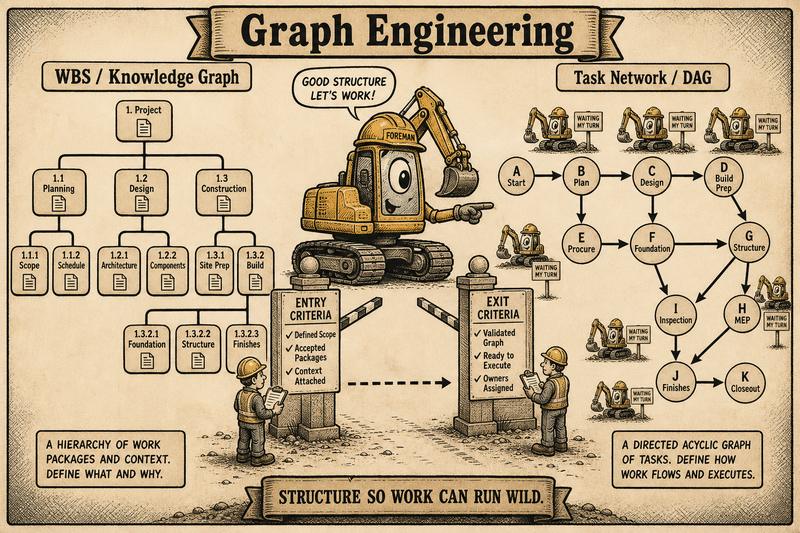
Graph Engineering: WBS, DAGs, and Agentic Teams
Prompt, context, harness, and graph engineering are concurrent requirements for solid workplans, for humans and agents. The WBS and the task DAG are how that structure shows up.
Read Article
The Re-Awakening of Systems Engineering
We are moving from "spec-then-code" to an iterative feedback loop where AI helps refine requirements. Why disciplined specification is the new superpower in the age of AI.
Read ArticleStart with a Diagnostic
A Diagnostic is a short, scoped engagement. We sit with your stack, your risk, and your readiness, and we write down what we find.
Ask about a Diagnostic